
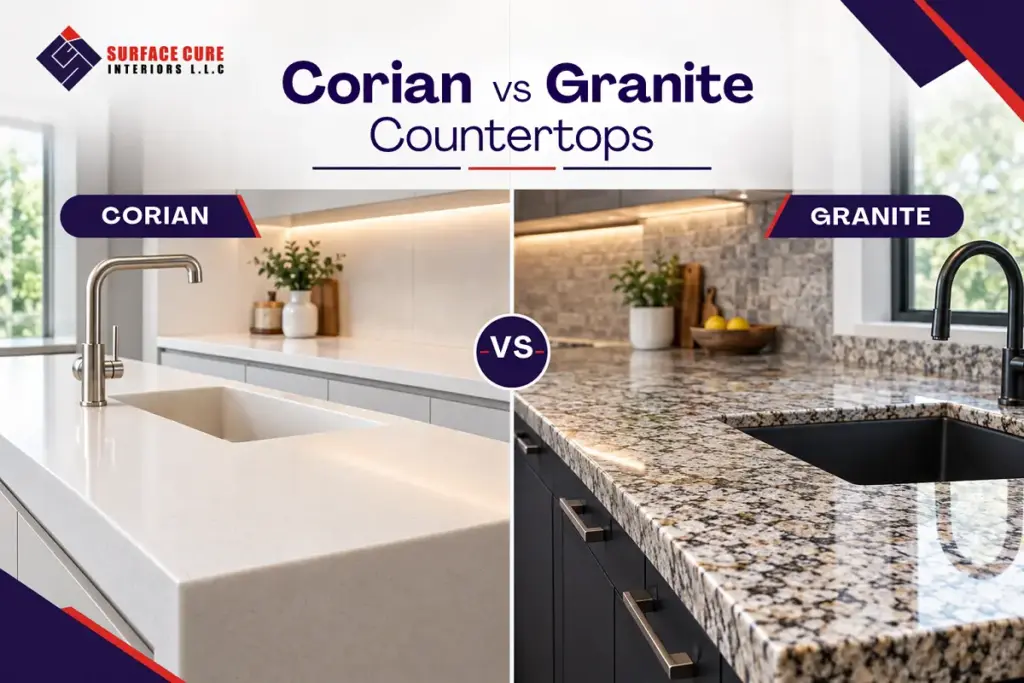
Choosing the right countertop is one of the most important decisions when designing or renovating a kitchen because it shapes the kitchen’s look. It withstands the harsh kitchen environment, including cooking, spills, heat, moisture, and handling.
UAE is a global hub of architecture and interior design, which offers customers to choose between the choice of a wide variety of materials for countertop making. Today, we will talk about Corian and Granite that are considered the most popular options among all. Both these distinct materials are famous for creating attractive and long-lasting kitchen surfaces. Granite is a natural stone, whereas Corian is made of Solid Surface that is specifically manufactured for a smooth, non-porous, and highly customized finish.
Which One is a Better Choice for UAE kitchens?
The answer to this question depends on your expectations for your kitchen countertop. Granite will suit you if you prefer a natural and classical look. Moreover, Granite is a good heat resistor. Whereas, Corian is the choice of those customers who are looking for seamless, versatile designs and have greater flexibility in fabrication.
Let’s have a deep analysis of these two materials.
What is Corian?
Corian is a product manufactured from acrylic-based material along with natural minerals and color pigments (you can visit the link to learn more about Solid Surface).
Corian is famous for its smooth and consistent appearance. Every slab of Corian can be made identical to each other, which gives uniformity in designing and coloring. Natural stones cannot be identical to each other.
Corian has the advantage of thermoforming, which means, “It can be converted or molded into any shape at a certain temperature”. So, you can choose it to make seamless curved counters, integrated sinks, and designs, which are hard to achieve from natural stones.
Corian has an upper hand in terms of non-porousness. If it is maintained and fabricated properly, no liquid can be absorbed into it, which makes cleaning an easy task. These hygienic features motivate people to choose Corian in kitchens.
What is Granite?
Granite is one of the hardest stones on earth and has been used for countertops for decades. It is obtained from the earth in large pieces; later on, it is cut to the required dimensions.
Each slab of granite is unique in its color and pattern. People who are uniqueness-conscious and appreciate the natural beauty of stone select it as their kitchen countertop.
Another positive aspect of granite is its strength and heat resistance. If it is installed and cared for properly, it can serve you for many years. However, granite is not free from maintenance. Periodic sealing is mandatory to stop moisture penetration and staining.
Corian vs Granite: A Direct Comparison
Understand the difference on the basis of certain characteristics that matter a lot in the kitchen.
Appearance and Design:
Granite has its own personality and beauty, so it is hard to reproduce the same color patterns again. Every slab has its own grain and colors, making it a unique feature in kitchens.
Corian is a man-made product and works on a different principle. Fabricators can manipulate it in any color or design. You can get any design, color, or pattern you desire.
If you wish to have an integrated sink and a joint-less appearance in your house, Corian can serve you in this regard.
On the other hand, if you have a taste for natural stone and want to have different looks in all your countertops, Granite will provide it. Whereas, if you wish to see a consistent and modern look, Corian is a better option.
Seams and Joints:
In the area of seams and joints, solid-surface material like “Corian” has an upper hand and is unmatched.
Granite’s countertops are made up of slabs; when complex structures are made, joints and seams become inevitable. Experts try to keep these joints neat, but they remain visible.
Whereas Corian can be thermoformed, joints become invisible by using adhesives and fabrication. These joint-free surfaces become the first choice for islands, counters, and contemporary kitchens.
Corian is the “winner” here.
Heat Resistance:
Kitchen countertops face hot cookware, baking trays, and other heated pots, so they need to be heat tolerant.
Granite is very heat resistant and can bear the high temperatures of the kitchen. However, it is wise to use trivets while dealing with very high-temperature wares.
On the other hand, Corian cannot tolerate high temperatures. You are not supposed to place very hot objects on these surfaces, as it could cause damage to these surfaces, but it can still be repaired. Making a habit of using trivets can prolong the life of these surfaces.
Maintenance and Cleaning:
A busy household’s kitchen countertop demands regular cleaning and maintenance.
Corian has a non-porous surface, so routine cleaning is quite easy. Any spilled thing can be wiped up easily without any material absorbing liquid.
Granite is also relatively easy to clean, but it requires more attention to sealing and maintenance. The performance of granite can vary depending on the specific stone, finish, and quality of installation.
It is also easy to clean, but it has seals and pores. Granite requires routine maintenance to fill these pores. Granite’s performance can vary from stone to stone and quality of fabrication.
“Both these materials should be avoided when cleaning with harsh chemicals.”
Corian has an edge due to low maintenance costs.
Resistance Against Stains:
Kitchen countertops are frequently stained with coffee, oils, spices, tea, and other items that leave their marks.
As it’s mentioned earlier, Corian is non-porous, so there is no chance of penetration of liquids in it. It can resist any kind of stains.
Granite’s resistance to stains depends upon the stone and its proper sealing. A well-finished granite can give relief, but neglecting sealing can make it prone to staining.
The winner is Corian.
Reparability and Durability:
All types of countertops face damage. It could be minor scratches or accidental damage that happens due to aging.
Solid surface has the ability that minor scratches can be repaired with perfection by experts. Whereas Corian is also considered to be durable if handled with care, Corian surfaces get the guarantee of 10-20 years and can last for longer periods.
Granite is also considered durable, but its repair could be a tough task. The damaged granite may require complete stone replacement.
On the basis of this analysis, having Granite could be an expensive choice as compared to Corian.
UAE’s Climate Effect?
UAE is considered to be one of the toughest geographical locations, and the selection of interiors is also dependent on its climate.
Although outer temperature is high, that determine the selection of countertop, its effect is relatively low because the kitchens are usually air-conditioned here.
The main determinant of selection is the owner’s way of using the kitchen. This means that if the kitchen is frequently used and hot wares are placed one after another on the countertop, Granite can help you in this regard.
Whereas, if the owner desires easy cleaning, integrated sinks, and a modern look without any pores, Corian will be an attractive option.
The UAE’s preference for contemporary villas, apartments, hotels, and commercial interiors also makes design flexibility an important consideration. Solid-surface materials can be fabricated into customized shapes and details that suit modern interior concepts.
Which is More Hygienic?
Hygiene is an increasingly important consideration for kitchen surfaces.
Corian’s non-porous nature is one of its key advantages. Properly fabricated surfaces with well-finished joints provide fewer places for liquids and food residues to penetrate.
Granite can also be used successfully in hygienic kitchen environments, particularly when the surface is properly sealed and cleaned. However, its natural structure requires maintenance and sealing that should not be overlooked under any circumstances.
For homeowners who want a surface that is easy to clean and maintain as part of their daily kitchen routine, Corian has a clear advantage.
Is Corian More Expensive Than Granite?
There is no simple answer because countertop pricing depends on several factors.
The answer is not very simple, as the price is dependent upon several factors. So, cost can be determined by:
- Brand and quality of material
- Color and pattern of surface
- Thickness of surface
- Size
- Number of joints
- Edge quality
- Sink-integration
- Cut-outs
- Curvy or thermoformed shapes
- CNC fabrication
- Installation requirements
- Transportation costs and site conditions
Homeowners are recommended to compare complete quotations before final decision, not just the comparison of only the price per square meter.
Choosing the Right Solid-Surface Fabricator:
Apart from the material for the countertop, there is another major contributor to your home’s beauty: its fabrication and installation. An expert can change the look of your kitchen by using their techniques and experience.
Homeowners who are going to choose Corian, or other solid surfaces, in their kitchens can contact our expert team for installation. We not only perform installation, but can also help you with the maintenance of damaged surfaces.
Surface Cure Interiors will be happy to answer any of your queries regarding Solid Surface installation and repair; just feel free to contact us.