
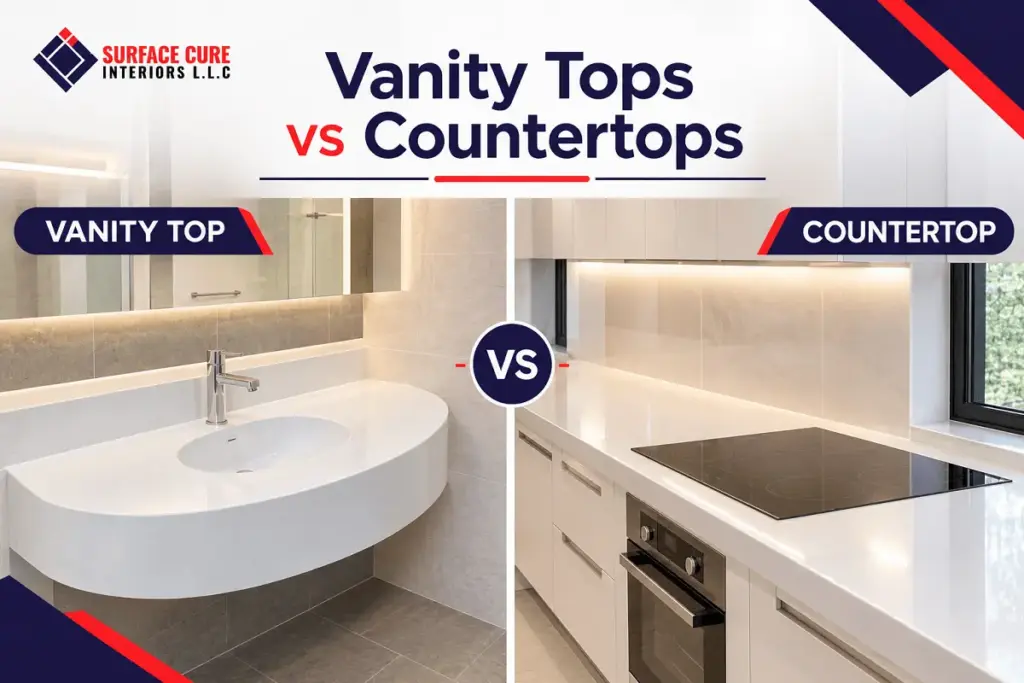
Choosing the right surface is an important step when you renovate or build your kitchen and bathroom. Vanity tops and countertops look very similar, and both can be made from the same materials, such as stone, quartz, laminate, or solid surface. Whereas these surfaces are made for very different places.
A countertop is associated with kitchens, utility rooms, and places where a durable surface is required. On the other hand, vanity top is purely designed for bathroom vanities, help for sink faucet and bathroom storage unit.
Let’s compare these surfaces to understand the key differences between them.
What is a Vanity Top?
A vanity top is the horizontal surface installed on top of a bathroom vanity cabinet. It provides a finished surface around the washbasin while protecting the vanity cabinet from everyday moisture and water exposure.
Unlike a simple countertop, a vanity top is often manufactured with a sink opening or an integrated basin. It may also include pre-drilled holes for faucets and other bathroom fixtures.
Vanity tops are available in a wide range of materials, colors, patterns, thicknesses, and edge profiles. Depending on the design, homeowners can choose a seamless integrated sink, an under-mount sink, a vessel sink, or another basin configuration.
One of the major advantages of a custom vanity top is that it can be manufactured according to the exact dimensions of the bathroom and vanity cabinet.
Common Applications of Vanity Tops
Vanity tops are commonly used in:
Residential bathrooms
Master bathrooms
Guest bathrooms
Powder rooms
Hotel bathrooms
Office washrooms
Restaurants and commercial washrooms
Healthcare and hospitality facilities
Because bathrooms are exposed to water and humidity, the selected material should be suitable for frequent moisture exposure and easy to clean.
What is a Countertop?
A countertop is a work surface installed over cabinets or a supporting structure. Countertops are particularly common in kitchens, where they provide space for food preparation, appliances, serving, and everyday household activities.
However, countertops are not limited to kitchens. They can also be used in laundry rooms, reception areas, offices, bars, retail spaces, laboratories, and commercial environments.
Kitchen countertops generally need to withstand more demanding activities than bathroom vanity tops. They may be exposed to food, spills, cooking equipment, sharp objects, heavy utensils, and frequent cleaning.
Common countertop materials include:
Quartz
Granite
Marble
Porcelain
Solid surface
Laminate
Stainless steel
Other engineered materials
The countertop depends on certain things such as where it is required, the client’s design preferences, maintenance requirements, and the client’s budget.
Vanity Tops vs Countertops: The Main Difference
The simplest way to understand the difference is to consider where the surface will be installed and what it needs to do.
A vanity top is primarily designed for bathroom use, while a countertop is a broader term for a work surface, particularly in kitchens and other functional areas.
Feature Comparison
| Feature | Vanity Top | Countertop |
| Typical location | Bathrooms | Kitchen and other Workplaces |
| Main purpose | Provides support to the sink and gives a decorative look in the bathroom | Food preparation, work, storage, and general use |
| Sink integration | Very common | Common in kitchens but not always required |
| Water exposure | Frequent | Moderate to frequent |
| Heavy-duty use | Generally lower | Often higher |
| Design focus | Bathroom aesthetics and hygiene | Functionality, durability, and aesthetics |
| Typical size | Often smaller | Usually larger |
| Customization | High | High |
| Common materials | Solid surface, Quartz, Marble, Porcelain | Solid Surface, Quartz, Granite, Marble |
This does not mean that one material cannot be used for both applications. In fact, many modern surface materials can be customized for bathrooms and kitchens alike.
These differences are primarily related to application and design requirements.
Material Choices for Vanity Tops
Right material selection is essential as the bathroom surfaces regularly bear water, soap, cosmetics, cleaning products, and humidity.
Solid Surface
Solid surface is one of the trending options for contemporary bathrooms because it can be fabricated into smooth and seamless designs. Many solid-surface materials can be crafted with integrated sinks.
The invisible joints around an integrated basin can create an elegant surface while making the surface easier to maintain.
Upon damaging, Solid surface can also be repaired or renovated in many cases, depending on the type and extent of damage.
Quartz
Quartz is another option for vanity tops. It’s an engineered material available in numerous colors and patterns, including designs that resemble natural stone.
Quartz’s appearance makes it suitable for modern, traditional, and luxury bathroom designs.
Natural Stone
Granite and marble are natural stones that are also being used for vanity tops. Natural stone gives a distinctive appearance because every slab has its own pattern and variation.
However, maintenance requirements can vary depending on the stone. Some natural stones may require sealing and more careful care than engineered surfaces.
Material Choices for Countertops
Kitchen countertops require certain actions to handle a wider range of demanding activities.
Quartz Countertops
Quartz countertops are selected for kitchens because they combine an engineered appearance with a broad range of colors and patterns.
They are available in designs ranging from subtle solid colors to surfaces inspired by marble and natural stone.
Granite Countertops
Granite is another popular natural-stone option for kitchens. Each slab keeps a distinctive appearance, making it suitable for homeowners who wish for natural variation.
Solid Surface Countertops
Solid surface is a widely used option for countertops. One of its key advantages is its ability to create smooth looks, integrated sinks, and backsplashes.
As the matter of fact, solid surface can be fabricated into several shapes; it is particularly useful for customized interiors.
Vanity Tops and Countertops for Modern UAE Interiors
Bathrooms and kitchens are important elements of both residential and commercial interior design in the UAE. Homes, hotels, offices, restaurants, and property developers often search for surfaces that can give visual appeal along with practical performance.
The warm climate of the UAE and extensive use of air conditioners also make material selection an important consideration for interior spaces.
UAE property owners may consider factors such as:
- Moisture resistance
- Cleaning requirements
- Design preferences
- Durability
- Heat resistance
- Maintenance
- Availability of materials
- Fabrication costs
- Installation expertise
A surface that seems attractive in a showroom still needs to be appropriate for its intended application.
That’s why discussing with an experienced solid surface manufacturer, supplier, or fabricator in the UAE can be a valuable step while selecting and installing custom surfaces.
How to Choose the Right Surface
Before the selection of a vanity top or countertop, keep in mind few simple questions.
Where is the surface going to be installed?
There is a big difference between a bathroom vanity, kitchen island, laundry room, reception desk, and commercial washrooms, so the considerations will be different.
How will the surface be used?
Give attention, either the surface will mainly support a bathroom sink or whether it will be used for food preparation and other demanding activities.
How much maintenance are you comfortable with?
Different materials cost differently. Consider how frequently the surface will be cleaned and what type of cleaning material is going to be used.
What appearance do you want?
Do you prefer a marble-inspired appearance, a minimalist solid color, a natural stone pattern, or a completely seamless contemporary look?
Do you need an integrated sink?
If you want the sink and surface to appear as one continuous unit, solid surface can be a reliable option because of its fabrication possibilities.
What is your budget?
The overall cost depends on the material, dimensions, thickness, edge profile, cutouts, fabrication, transportation, and installation.
Rather than comparing only the price per square meter, you need to consider the complete project cost.
Final Thoughts
Vanity tops and countertops can appear similar, but their applications at home are different. A vanity top is primarily manufactured for bathroom vanities; on the other hand, a countertop generally provides a functional work surface in kitchens and other areas.
Your choice should be simple. Start by identifying the room, understand how the surface will be used, and then relate suitable materials based on appearance, maintenance, durability, fabrication options, and budget.
If you are the homeowner or running a business and looking for customized interiors, Surface Cure Interiors can help you in the selection of durable Solid Surface and can offer considerable design flexibility. From bathroom vanity tops with integrated basins to customized kitchen countertops, professional fabrication like ours can help turn a design concept into a practical finished surface.
Ultimately, the right surface is not only an attraction at home. It is the one that fits in your space, supports your intended use, complements the interior design, and meets the practical requirements of everyday life.
Our company can help you not only with the manufacturing of the Vanity Tops and Countertops, but also with the maintenance of already available surfaces. We provide refurbishment and renovation services at your doorstep.